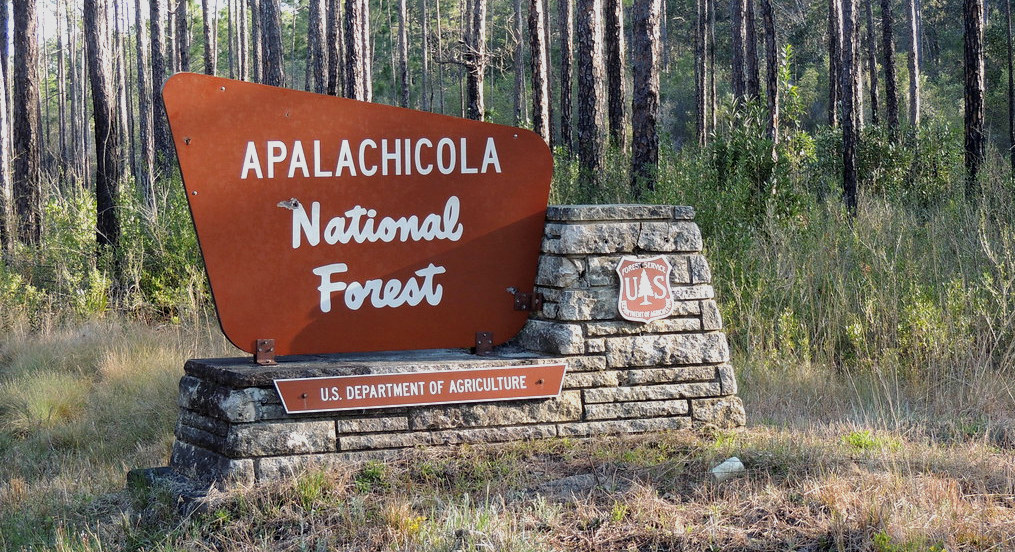
The Apalachicola National Forest, established in 1936, is the largest national
forest in Florida, spanning over 576,000 acres across the Panhandle. While it
stretches across four counties, the portion within Wakulla County represents the
forest’s eastern district, occupying the entire western half of the county.
This region is a vital ecological transition zone
where the high, sandy "Munson Sandhills" meet the low-lying coastal plains and
the dramatic limestone formations of the Woodville Karst Plain.
One of the defining features of the Wakulla County section is the
Leon Sinks Geological Area. Unlike the flat, swampy pine savannas found further
west, this area is characterized by karst topography—a landscape formed by the
dissolving of underlying limestone. Here, the ground has collapsed into a series
of spectacular wet and dry sinkholes, disappearing streams, and natural
bridges.The Leon Sinks are part of one of the most extensive underwater cave
systems in the world, which hydrologically connects directly to the famous
Wakulla Springs. Visitors can explore this "Swiss cheese" geology via a series
of interpretive trails, including the Sinkhole Trail, which leads to Big Dismal,
a 100-foot-deep sinkhole filled with striking turquoise water.
Wakulla’s side of the forest is also home to the Silver Lake
Recreation Area, the largest developed recreation site in the entire forest.
Situated just south of State Road 20, Silver Lake features a 250-foot white sand
beach and a mile-long interpretive trail that winds through a lush forest of
longleaf pine, ancient cypress, and moss-draped oaks. It is a premier
destination for swimming, non-motorized boating, and picnicking.
Further south
lies the Bradwell Bay Wilderness, a massive, primitive "bay" or swamp of titi
trees and hardwoods. This area is famously difficult to traverse; the Florida
National Scenic Trail cuts through its center, often requiring hikers to wade
through waist-deep water. It offers a glimpse into the wild, prehistoric Florida
that existed before modern drainage and development.
Ecologically, the Wakulla district is a stronghold for the endangered
red-cockaded woodpecker. You can often spot their nesting sites—marked by
distinct white rings painted on longleaf pine trunks—along the forest roads. The
area is also home to black bears, gopher tortoises, and rare carnivorous plants
like pitcher plants that thrive in the boggy "savannah" patches. Because this
ecosystem relies on fire to clear out invasive hardwoods and stimulate the
growth of wiregrass, the U.S. Forest Service conducts one of the most active
prescribed burn programs in the country here. This management ensures that the
Wakulla portion of the forest remains an open, sun-drenched woodland, preserving
the iconic "Old Florida" landscape for future generations.
Note: The location shown on our map for Apalachicola National
Forest is simply a road intersection near the center of the Wakulla section of
the forest. There are no visitor or interpretive centers within the forest in
Wakulla County.
Activities & Facilities
Picnic shelter

Dogs allowed
Short hiking trails
Long hiking trails
Paved bike trails
Mountain bike trails
Horse trails
Swimming
River or lake kayaking
Motor boating
ATVs/motorcycles allowed
Tent camping
Hunting
Fishing